Risk and Resilience of Complex Systems (RRCS), Industrial Chair, 2024 - 2029
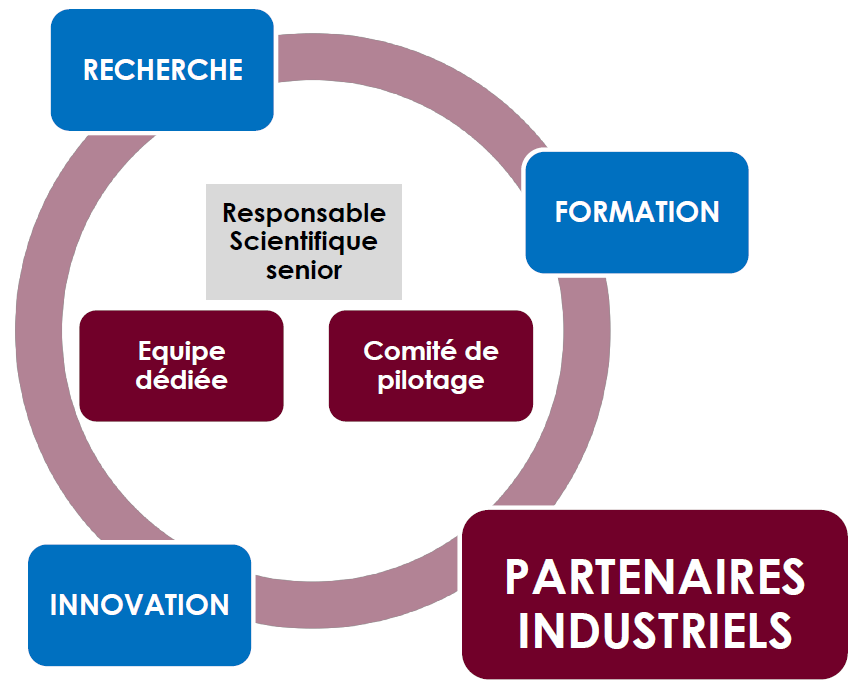
The industrial Chair is supported by three industrial partners: Électricité de France (EDF), Orange, and the Société nationale des chemins de fer français (SNCF). This is an arena to define study cases, share knowledge data and experiences, develop methods, and implement benchmarks and prototypes of tools.
The scientific project includes three main axes:
- Modelling of systems of systems and their interdependences for risk management and resilience between several operators
- Modelling and optimisation of maintenance tasks in order to reduce their impact
on service continuity (internally and between operators) - Common models and methods platform
Strategic Power Systems Development for the Future (PowDev), PEPR TASE project (France 2030), December 2023 - March 2029
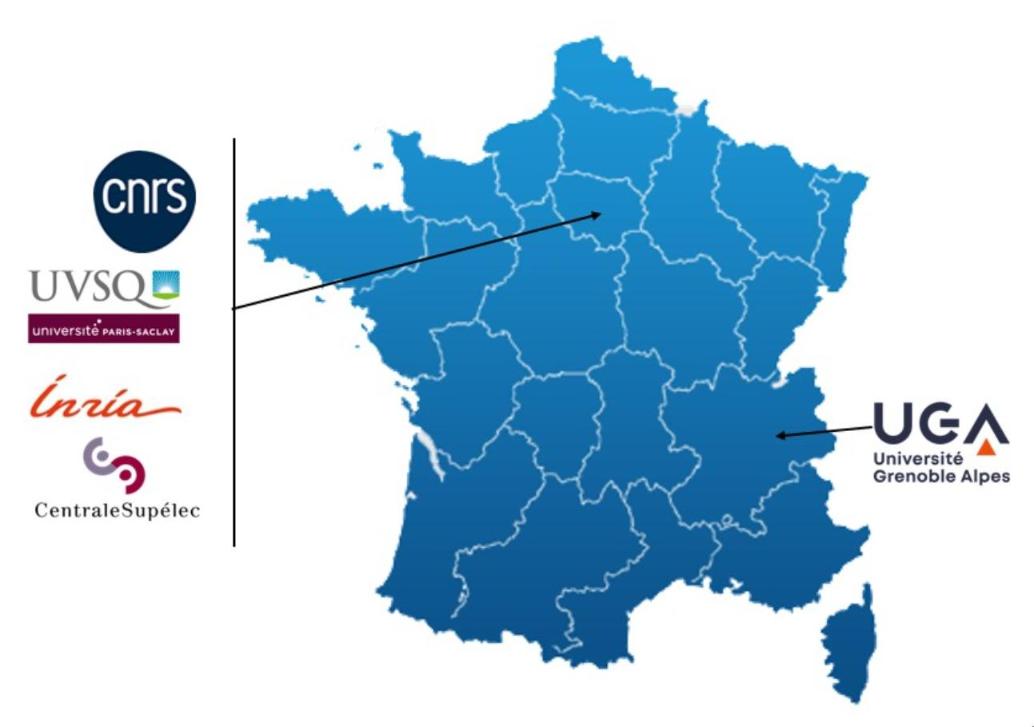
PowDev aims to assess and optimize the resilience of power systems facing a massive integration of renewable energies, considering extreme weather events (droughts, storms, thunderstorms) in current and future climates, cascading failures in complex networks, and socio-economic scenarios. The project addresses three questions: (1) how extreme events impact power grids and how resilience can be characterized and measured using complex systems theory; (2) which economic and societal scenarios lead to blackouts under high shares of renewables; (3) how design and operation decisions can be optimized, proactively and robustly, to make power systems more resilient. PowDev is coordinated by Anne Barros (CentraleSupélec, LGI R3) with CNRS, Inria, UVSQ and Université Grenoble Alpes.
More information: ANR project page | PEPR TASE project website
Doctoral network on turbomachinery with two-phase flow (Training42Phase), Horizon Europe MSCA Doctoral Network, December 2023 - November 2027
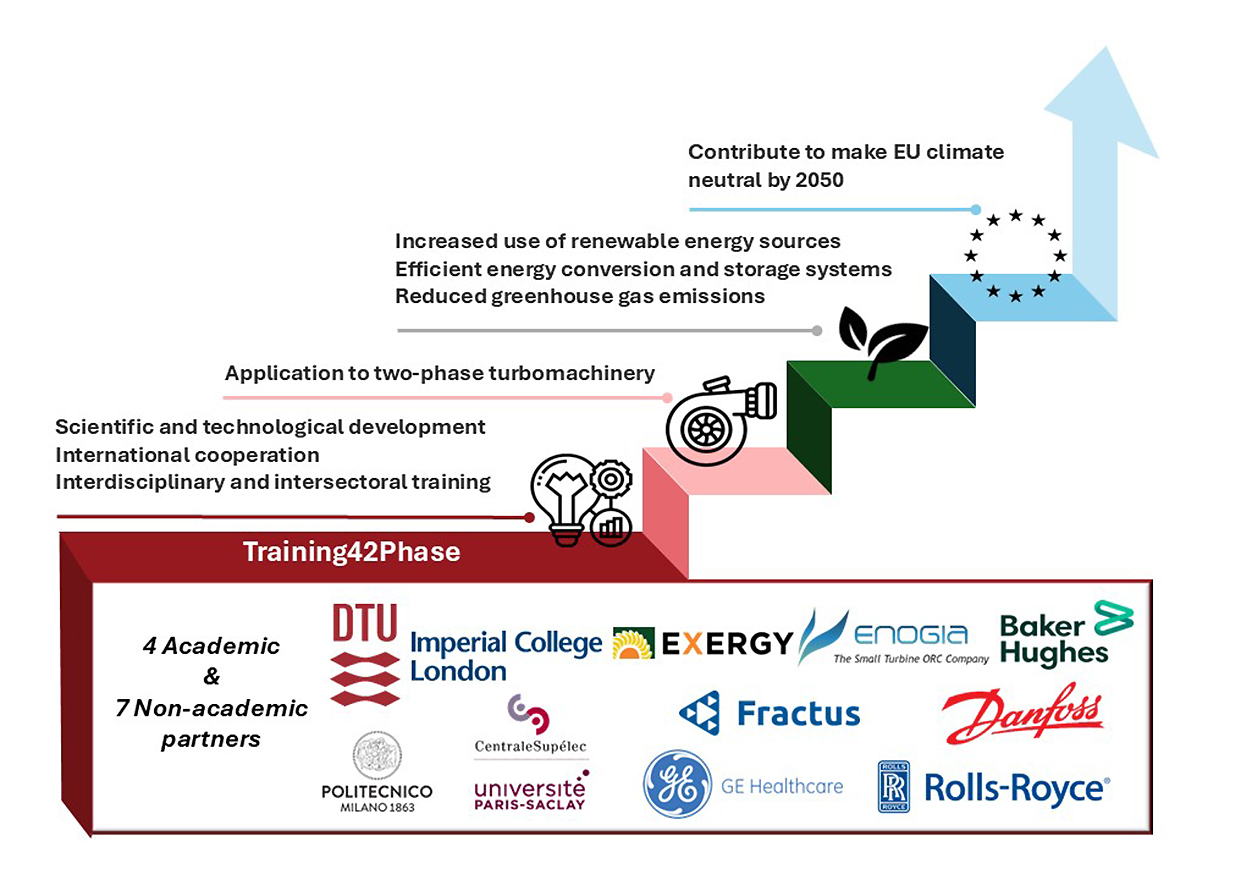
Training42Phase trains 12 doctoral candidates to become the future leading scientists in turbomachinery with two-phase flow, a key technology for novel energy conversion systems in the green transition. The training covers aerothermal modelling and design, stress and fatigue analysis, structural dynamics, hybrid/data-driven failure mechanism models, advanced optimization and machine learning. The consortium, led by the Technical University of Denmark (DTU), includes Politecnico di Milano, CentraleSupélec and Exergy International, together with academic and industrial associated partners such as Imperial College London, Rolls-Royce, Danfoss and Nuovo Pignone. CentraleSupélec leads WP2 (Training) and WP6 (Reliability and maintenance).
More information: Project website
Resilient and Sustainable Planning and Management of the Future Space Industry Infrastructure with On-Orbit Servicing (ReSuSpace), ANR funded project, 2024 - 2027
ReSuSpace develops decision-support tools based on operations research and AI for the optimal lifecycle management of space infrastructure, focusing on the planning of on-orbit servicing (maintenance, refueling, inspection) to extend the life of space systems. Coordinated by Adam Abdin (CentraleSupélec, LGI R3).
More information: ANR project page
Towards safer intrapartum electronic fetal monitoring: a human factors/ergonomics investigation (SaferEFM), ANR funded project, 2025 - 2030
SaferEFM studies intrapartum electronic fetal monitoring as a complex sociotechnical process, combining field observations, a national survey and verbal protocol analysis to understand how individual, team and organizational factors affect practice, in order to improve maternity safety. Coordinated by Guillaume Lamé (CentraleSupélec, LGI R3).
More information: ANR project page
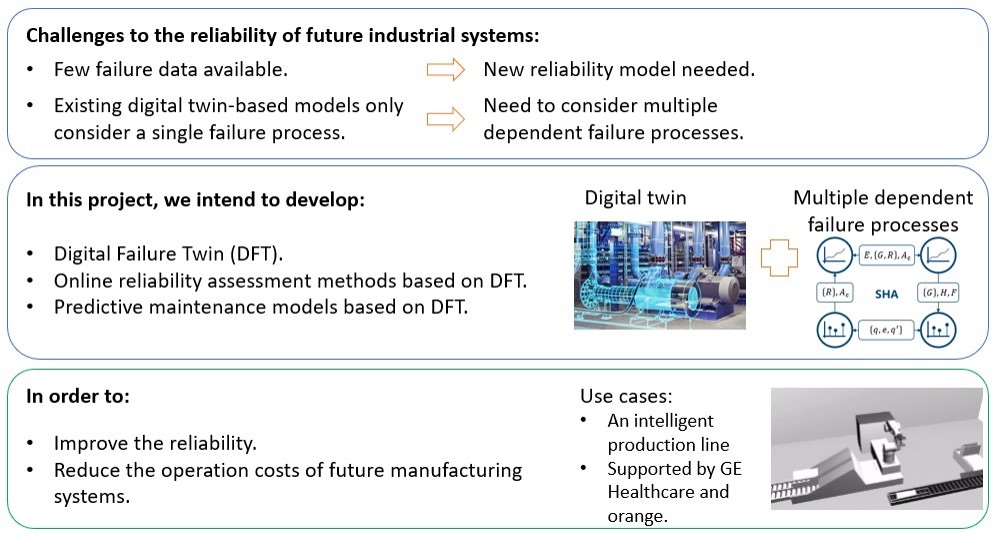
Digital Failure Twin for online reliability assessment and predictive maintenance of future manufacturing systems (DFT), ANR JCJC funded project, 2022 - 2026
The objective of the DFT project is to improve reliability and reduce operational costs of future manufacturing systems (e.g., intelligent production lines, smart factories) by developing digital twin-based failure models (called digital failure twin) to support online reliability assessment and predictive maintenance. More specifically, compared to the state-of-the-art methods, the developed methods would (1) more accurately quantify the reliability; (2) achieve more cost-effective maintenance scheduling through predictive maintenance.
Robust and scalable prescriptive analytics for the resilience of critical infrastructure networks (RoScaResilience), ANR JCJC funded project, 2022 - 2026
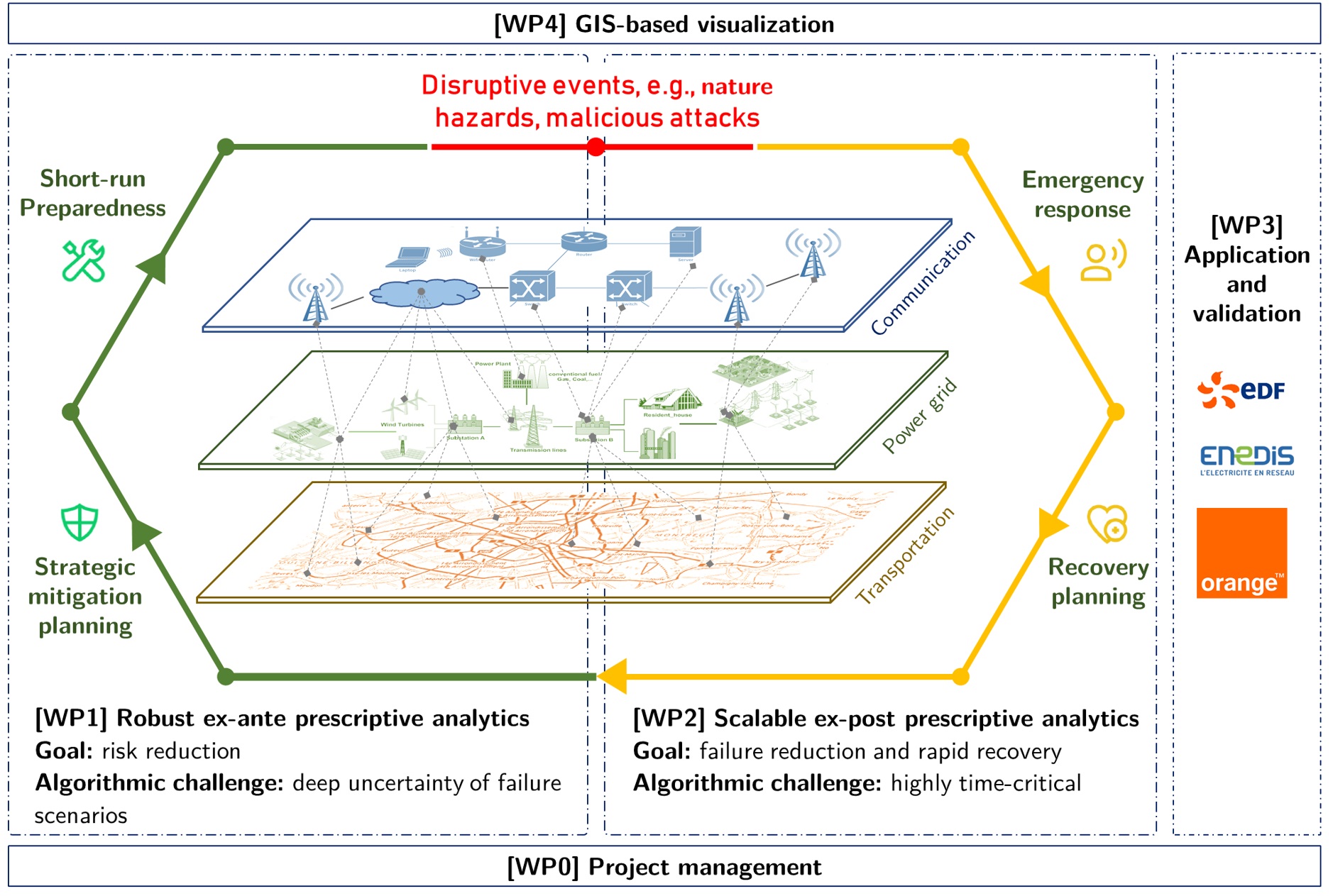
This project advances the body of knowledge on critical infrastructure network resilience by proposing robust and scalable prescriptive analytics to guide actions and decisions for effective resilience improvement. With this aim, we develop novel interdisciplinary approaches that integrate risk and resilience engineering, mathematical optimization, and (deep) reinforcement learning to improve 1) the ability to make robust planning of ex-ante strategic mitigation and preparedness actions under deep uncertainty of future disruptions caused by natural extremes, and 2) the ability to plan for effective ex-post response and recovery, emphasizing the computational efficiency of the method when applied to large-scale real-world systems.